How to Reclaim Your Focus in an Overstimulated World, Slow Living, Presence, and Mental Clarity
by Ana Sol
3/22/20265 min read
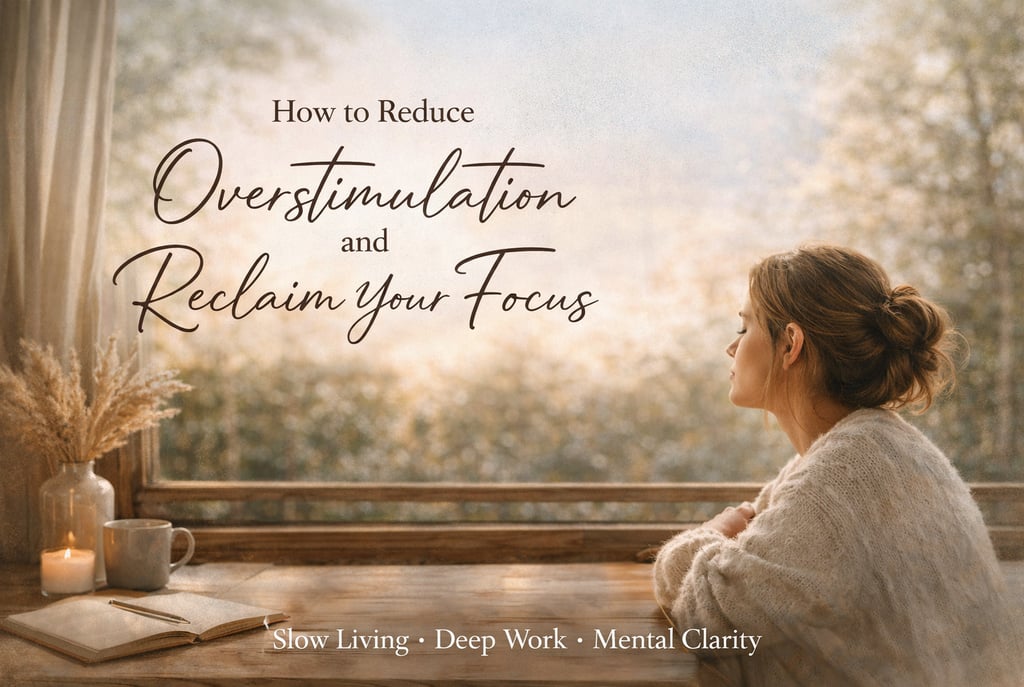
There is a quiet exhaustion that many people carry today, one that is not always visible, yet deeply felt.
It is not the exhaustion that comes from effort or meaningful work. It is a different kind of fatigue, one that emerges from constant interruption, fragmented attention, and a mind that rarely gets to rest in a single thought. We wake up and reach for our phones before we have even fully arrived in the day. Messages, notifications, updates, conversations, all begin to accumulate before our own inner voice has had space to speak.
This has become normal.
We have adapted to a rhythm of constant stimulation, where attention is divided, presence is diluted, and silence feels unfamiliar. Yet beneath this adaptation, something essential has been lost. The ability to focus deeply, to engage fully, and to experience life without the background noise of continuous input.
This is the hidden cost of the world we live in.
Modern environments are not designed to protect your attention. They are designed to capture it. Every notification, every scroll, every subtle prompt to check again is part of a system that thrives on keeping your mind engaged externally. Over time, this creates a state of overstimulation, where the brain is continuously processing, reacting, and switching, without ever settling.
And when the mind cannot settle, clarity disappears.
What many interpret as a lack of discipline or motivation is often something else entirely. It is cognitive overload. It is the result of a brain that has been trained to expect constant novelty, and that now struggles to remain with a single task long enough to enter depth. The problem is not that we cannot focus. The problem is that we have created conditions that make focus almost impossible.
One of the most common expressions of this is multitasking.
It feels productive. It gives the illusion of efficiency. Moving between messages, emails, tasks, and small decisions can create a sense of momentum, as if we are advancing quickly. But beneath that surface, the brain is paying a cost every time attention shifts. Each transition leaves a residue, a fragment of the previous task that lingers and reduces the quality of the next.
Over time, this fragmentation accumulates.
Work becomes shallow. Thinking becomes reactive. Creativity diminishes. Even simple tasks begin to feel heavier than they should. The mind is busy, but not effective. Active, but not clear.
In contrast, there is a different way of engaging with both work and life, one that is quieter, more intentional, and ultimately more powerful.


Single tasking.
To focus on one thing at a time may seem almost too simple, yet it is increasingly rare. It requires choosing where your attention goes, and more importantly, choosing what to ignore. It requires resisting the pull of constant input and allowing the mind to remain in one place long enough to deepen.
When this happens, something shifts.
The mind begins to organize itself. Thoughts become more coherent. There is less internal friction. What once felt scattered starts to align. A single task, given full attention, often moves forward faster and with greater quality than multiple tasks approached in fragments.
This is not about doing less. It is about doing what matters with clarity.
The challenge, however, is not only external. It is also cultural.
We live in a time where availability is expected. Being reachable, responsive, and constantly connected is often interpreted as responsibility or commitment. Choosing to step back, to disconnect, or to create boundaries around your attention can feel uncomfortable, even misunderstood.
There is a subtle pressure to remain present in every conversation, every group, every stream of information.
And yet, presence everywhere often means presence nowhere.
Personally, I have chosen to reduce unnecessary exposure to social media and constant messaging. I no longer feel the need to be available at all times, nor to respond immediately to every input. This decision was not about rejecting technology, but about redefining my relationship with it.
For over a month, I stepped away from WhatsApp.
At first, it felt unfamiliar. There was a sense of disconnection from the rhythm that everyone else seemed to follow. But gradually, something shifted.
My mind became quieter. The urgency softened. I found myself able to concentrate more deeply, to stay longer with a single task, and to experience moments with greater presence.
What also became clear is that not everyone understands this choice.
We have normalized constant availability to such an extent that choosing otherwise can seem unusual. But each person knows how they feel best. And in my experience, creating intentional distance from that constant need to be connected allows something essential to return.
You begin to reconnect with yourself.
This does not mean abandoning technology. It means using it consciously.
Technology, when used intentionally, can expand your thinking, support your growth, and open meaningful opportunities. Learning new tools, exploring artificial intelligence, taking courses, building ideas, these are uses that add depth and direction.
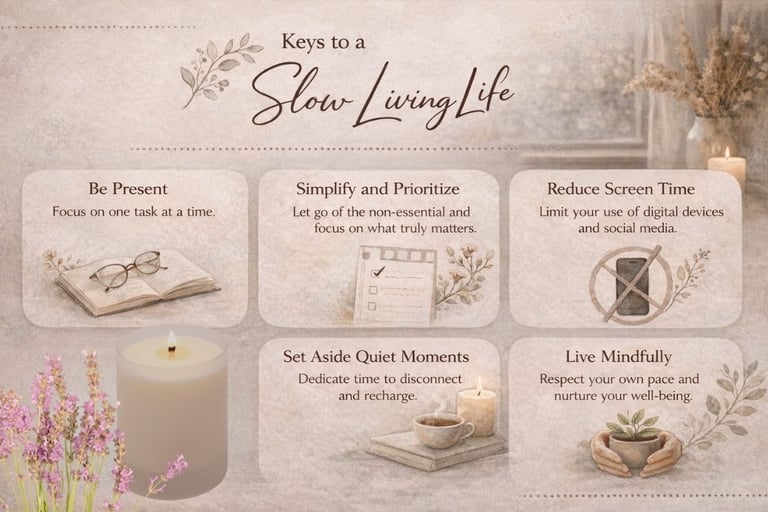
In contrast, passive consumption and non essential social exposure often do the opposite. They fragment attention, increase comparison, and quietly drain energy.
The distinction is not between using or not using technology.
It is between conscious use and unconscious consumption.
Reducing this noise requires intention. It is not a passive shift, but a conscious decision to reclaim ownership over your attention. For some, this begins with small adjustments. Turning off non essential notifications. Creating moments in the day that are free from screens. Allowing space between inputs instead of filling every silence.
For others, it may involve more defined boundaries.
Stepping away from certain platforms. Reducing participation in constant messaging. Allowing time to pass before responding. These choices can initially feel unfamiliar, even uncomfortable, because they go against the rhythm that has been normalized.
But with time, the effect becomes clear.
There is more space in the mind. Less urgency. A quieter internal environment. The ability to sit with a task, a thought, or even a moment without needing to reach for something else.
This is where slow living begins to take form.
Slow living is often misunderstood as a rejection of ambition or productivity. In reality, it is a refinement of both. It is the decision to align your energy with what is meaningful, rather than dispersing it across what is merely available. It is the recognition that depth creates more value than speed, and that clarity emerges not from doing more, but from removing what is unnecessary.
It is not about escaping responsibility, but about engaging with it more intentionally.
A focused mind is not only more productive, it is also more at peace. There is a different quality to work that is done with presence. A different quality to time that is experienced without distraction. Even simple moments, a morning coffee, a quiet walk, a single conversation, begin to feel more complete when attention is not divided.
In this sense, reducing stimulation is not a limitation. It is a form of expansion.
It allows you to return to your own rhythm, to think more clearly, to create with more intention, and to experience your life without the constant interference of external noise.
You do not need to disconnect from everything.
But you do need to become selective.
Because your attention is not infinite.
And what you give it to, shapes your reality.
Reclaiming your focus is not a dramatic shift. It is a series of small decisions, repeated daily. Choosing to pause before reacting. Choosing to finish one task before starting another. Choosing to sit in silence instead of filling it.
Over time, these decisions accumulate.
And what emerges is not only greater productivity, but something deeper.
Clarity. Presence. A sense of control over your own mind.
In a world that is constantly trying to pull your attention outward, choosing to bring it back inward is a powerful act.
One that changes not only how you work, but how you live.
Explore


2026 Mandarina y Menta.
All rights reserved.