How to Breathe Your Way Back to Calm
Discover how conscious breathing can reduce stress, improve mindfulness, and support slow living. Learn simple techniques to calm your nervous system and regain mental clarity through diaphragmatic breathing.
3/24/20264 min read
How to Breathe Your Way Back to Calm
The Missing Link Between Stress, Mindfulness, and Slow Living
There is a quiet function in your body that accompanies you every moment of the day. It often goes unnoticed, yet it shapes how you feel, think, and respond to the world.
Your breath.
In a world defined by constant stimulation, endless notifications, and the subtle pressure to always be available, many people live in a state of low-grade stress without fully realizing it. The mind feels scattered, the body accumulates tension, and clarity becomes harder to access.
What often goes unnoticed is that this state is not only psychological, it is physiological. And one of the most direct ways to influence it begins with something remarkably simple: how you breathe.
The Invisible Pattern Behind Stress
For many adults, breathing is no longer natural, it is conditioned.
Over time, the body adopts a shallow breathing pattern. Instead of engaging the diaphragm, the most efficient and natural mechanism, breathing becomes confined to the upper chest. The shoulders lift slightly, the neck activates, and the breath turns short and fragmented.
At first glance, this may seem insignificant. Yet this subtle pattern has a powerful effect.
Shallow breathing continuously signals to the body that something is wrong. It activates the sympathetic nervous system, responsible for the fight-or-flight response. As a result, even in safe environments, the body remains in a quiet but persistent state of alert.
This is why stress can feel constant, even in the absence of a clear cause.
The Breath as a Regulatory Tool
If shallow breathing reinforces stress, the opposite is also true.
When the breath slows down and deepens, the body receives a very different message: you are safe.
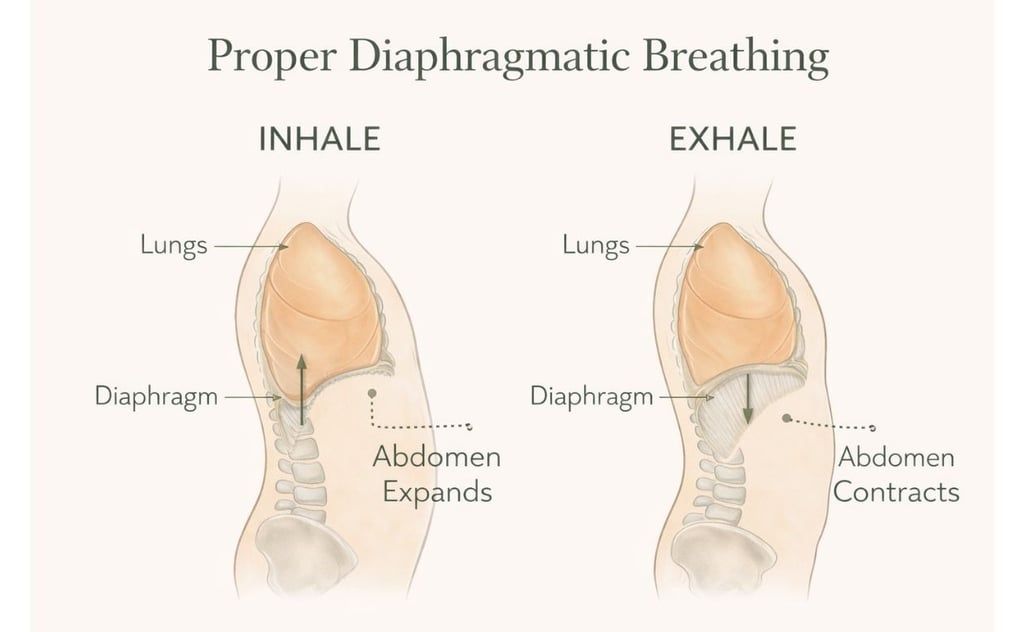
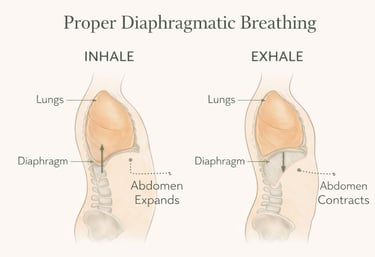
Diaphragmatic breathing restores this natural rhythm. As you inhale, the diaphragm moves downward, allowing the lungs to expand fully. The abdomen rises gently, while the chest remains relaxed. As you exhale, the body softens.
This shift activates the parasympathetic nervous system, responsible for rest, recovery, and balance.
The effects unfold gradually but clearly:
The heart rate stabilizes
Cortisol levels decrease
Muscular tension softens
Mental activity becomes less reactive
The body moves out of urgency and into regulation.
In this sense, breathing is not just a function, it is a lever. One that allows you to influence your internal state in real time.
Where Mindfulness Truly Begins
Mindfulness is often described as the practice of being present. But presence is not something you force, it is something you access.
And the most direct access point is the breath.
When you bring attention to your breathing, you shift from thinking about the moment to experiencing it. The breath becomes a steady, rhythmic anchor, something that is always available, always happening now.
Through this simple act, two things begin to occur simultaneously:
The mind slows down
The body releases tension
With repetition, this process trains the brain. Reactivity decreases, attention stabilizes, and emotional regulation improves.
Mindfulness, in this sense, is not an abstract concept. It is a physical experience, and breathing is its most natural entry point.
Slow Living as an Internal State
Slow living is often misunderstood.
It is commonly associated with aesthetics, calm spaces, quiet mornings, intentional routines. While these elements can support a slower life, they are not its foundation.
At its core, slow living is a nervous system state.
It is what happens when the body no longer operates under constant urgency, when it feels safe enough to slow down, to notice, and to fully engage with the present moment.
This state cannot be created externally alone. It requires internal conditions.
Your breathing pattern plays a central role in shaping those conditions. When the breath is shallow and fast, the body remains subtly alert, and time feels compressed. When it becomes slow and deep, the body shifts into safety, and experience begins to expand.
In this way, the breath is not just a tool for calm, it is the foundation of a more intentional way of living.
A Practical Way to Reset
Understanding this is important. Experiencing it is what creates change.
You do not need a complex routine. A few minutes of conscious breathing can shift your state noticeably.
Find a comfortable position, sitting or lying down. Let your body settle. Place one hand on your abdomen and the other on your chest.
Begin by observing your natural breath.
Then gently guide it:
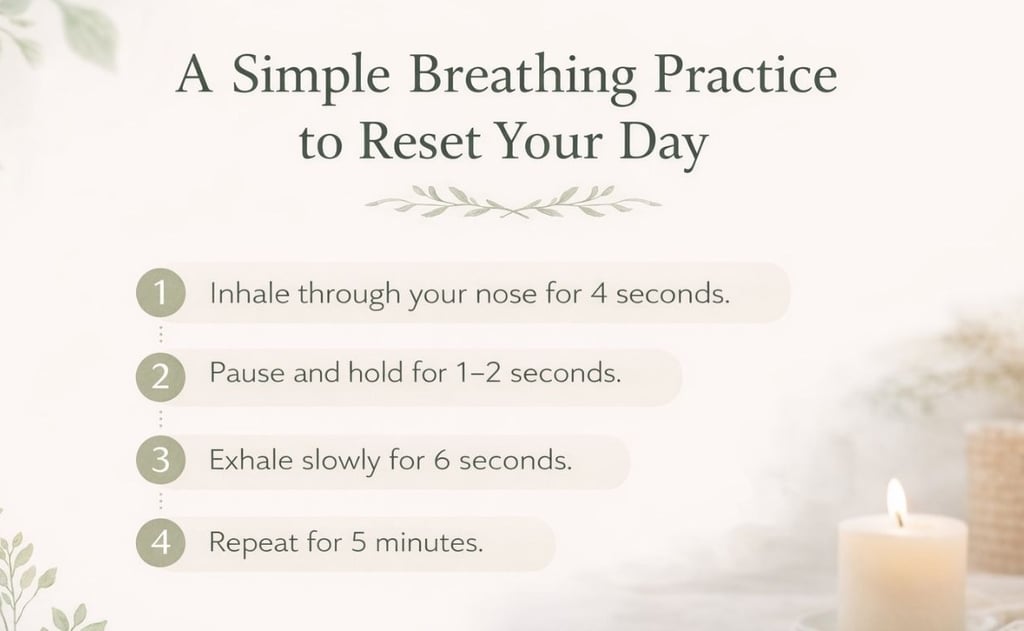
Inhale through your nose for about 4 seconds
Let your abdomen rise softly
Keep your chest relatively still
Pause briefly.
Exhale slowly for about 6 seconds
Allow your body to release tension
Continue at this pace.
Your mind will wander. That is natural. Each time it does, bring it back to the sensation of breathing. Not forcefully, just gently.
The practice is not about control, it is about returning.
After a few minutes, you may notice subtle changes, a sense of calm, more space in your thoughts, less internal pressure. These shifts may be quiet, but they are real.
Returning, Again and Again
We live in a culture that constantly pulls attention outward, toward productivity, information, and validation.
Breathing offers the opposite direction.
It brings you back.
Not through effort or intensity, but through simplicity.
Over time, this repeated act of returning begins to reshape your experience. The pace of your thoughts softens. Your reactions become less automatic. You begin to move through your day with more clarity and less urgency.
What starts as a simple breath becomes something deeper, a way of reconnecting with yourself.
And from that place, life does not necessarily become slower, but it does become more present, more intentional, and ultimately, more meaningful.
Explore


2026 Mandarina y Menta.
All rights reserved.